


Package Name:com.MD.use.NanoTubAR
SHA-256:afb712335dbb0a2b60e7e80b6d906d782ec7abd3569892e915e5ef64053303eb
Show More
"Nanoscience" is the branch of science that is responsible for the study of objects at the nanometric scale, that is, those whose sizes are between 1 and 100 nm. One of the great challenges of nanotechnology is the preparation of new functional materials whose dimensions and structures are controlled at the molecular or atomic level. In chemistry, nanotubes are tubular (cylindrical) structures, whose diameter is the size of a nanometer.
There are nanotubes of many materials. Among the best known are carbon nanotubes (CNTs) formed by rolled sheets of carbon atoms, with physical and chemical properties that open up an immense horizon of applications.
In addition to carbon nanotubes, there are nanotubes made up of cyclic peptides. This type of nanostructures has attracted great attention from the scientific community in recent years due to its important applications in biology, chemistry and materials science. Much of this interest is related to its technological possibilities such as biosensors, photosensitive materials, antimicrobial agents, selective transport systems, molecular electronics and other potential uses in biology, electronics and optics. The history of these nanotubes began in 1974, when De Santis predicted the formation of tubular structures by cyclic peptides, formed by alpha amino acids with alternating stereochemistry, D and L (D, L-α-CPs). However, it was not until 1993 that they managed to prepare in a laboratory thanks to Professor Ghadiri's group at Scripps. Its applications include those that involve interaction with membranes, including the use as antimicrobials or as biomimetics of natural channels. Its hydrophilic internal cavity facilitates the transport of water and hydrophilic molecules of appropriate size, such as ions. The external properties of the nanotube are defined by the side chains of the amino acids that make up the cyclopeptide, oriented towards the outside of it.
Subsequently, in the group of Prof. Juan R. Granja, at the University of Santiago de Compostela, nanotubes formed by cyclopeptides that alternate alpha amino acids with other types of artificial amino acids, such as gamma (α, γ- CPs) or delta (α, δ-CPs). This type of non-natural waste allows methylene groups to be introduced into the cavity of the channels, increasing their hydrophobicity and allowing their internal functionalization.
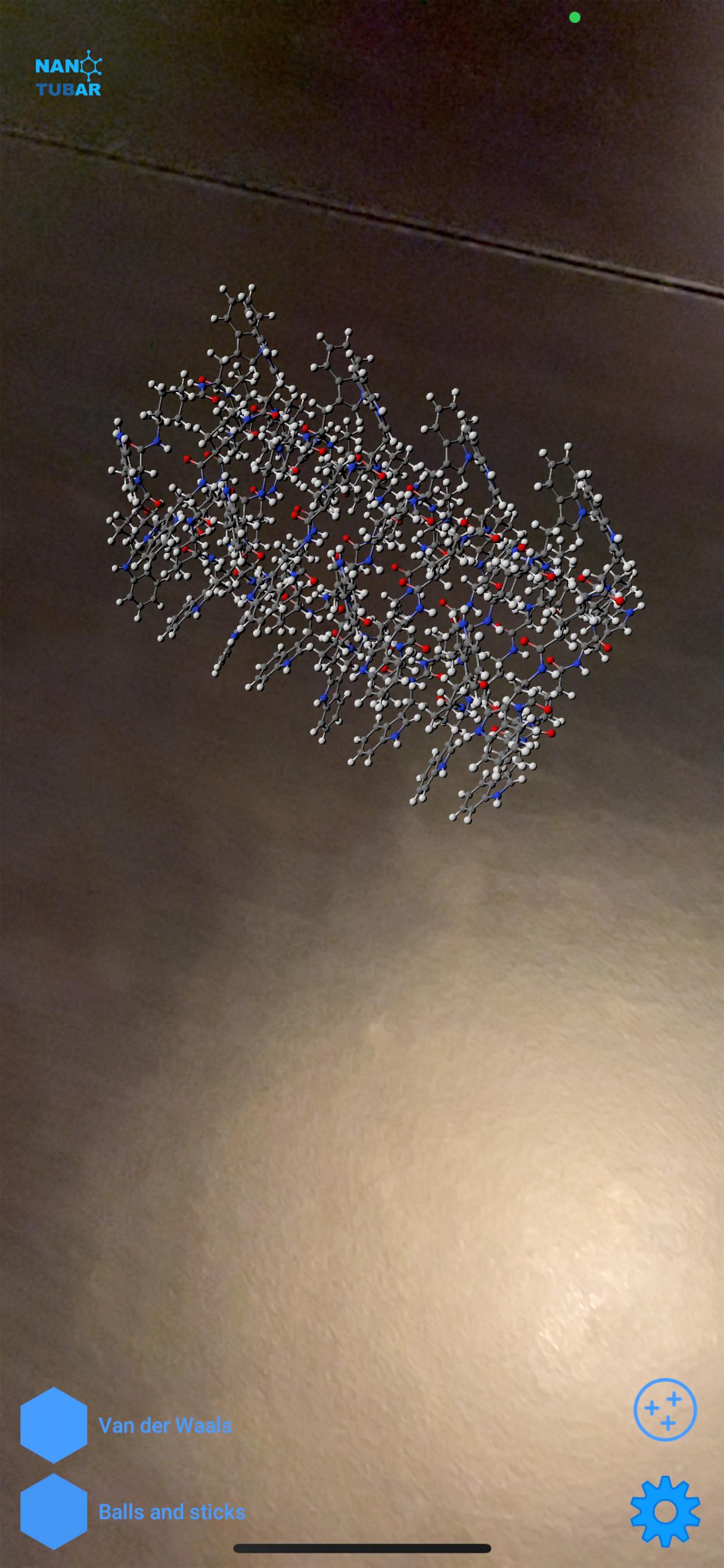
NanotubAR allows to visualize, using Augmented Reality technology, four types of nanotubes: a carbon nanotube (CNT) and three nanotubes formed by cyclic peptides. In each of them, natural alpha amino acids (L-tryptophan) are combined with synthetic residues, such as D-tryptophan (D, L-alpha-CPs), gamma amino acids (alpha, gamma-CPs) and delta amino acids (alpha, delta -CPs). In all these designs, the amino and carbonyl groups of the amino acids are oriented perpendicular to the plane of the cyclic peptides, with a suitable orientation to establish hydrogen bonds between the different units, and thus form a tubular structure.
With NanotubAR it is possible to obtain a privileged view of these systems in our own home, or anywhere from a simple texture, walk around it, and even enter its interior cavity to be able to observe its interior structure in detail at a level atomistic detail. In addition, NanotubAR allows changing the representation of the atoms that make up the systems and choosing between “ball and stick” or a van der Waals representation. Delve into nanotechnology and share with your friends a photo inside your favorite nanotube!
Latest Version
1Uploaded by
Banu Banu
Requires Android
Android 7.0+
Category
Free Education AppContent Rating
Everyone
Security Report
Check Now
Report
Flag as inappropriateLast updated on Oct 6, 2022
A través de la Realidad Aumentada, NanotubAR permite visualizar modelos moleculares de diferentes nanotubos (peptídicos y de carbono), con una resolución atomística.





APKPure - A multi-platform app store primarily focused on Android, providing extensive app-related content. Discover the app you want easier, faster, and safer, with quick and efficient downloads and installations.