**************************Java Servlet tutorial*******************
Servlets are most often used to process or store a Java class in Java EE that conforms to the Java Servlet API,[2] a standard for implementing Java classes that respond to requests. Servlets could in principle communicate over any client–server protocol, but they are most often used with the HTTP protocol. Thus "servlet" is often used as shorthand for "HTTP servlet".[3] Thus, a software developer may use a servlet to add dynamic content to a web server using the Java platform. The generated content is commonly HTML, but may be other data such as XML. Servlets can maintain state in session variables across many server transactions by using HTTP cookies, or rewriting URLs.
To deploy and run a servlet, a web container must be used. A web container (also known as a servlet container) is essentially the component of a web server that interacts with the servlets. The web container is responsible for managing the lifecycle of servlets, mapping a URL to a particular servlet and ensuring that the URL requester has the correct access rights.
The Servlet API, contained in the Java package hierarchy javax.servlet, defines the expected interactions of the web container and a servlet.[3]
A Servlet is an object that receives a request and generates a response based on that request. The basic Servlet package defines Java objects to represent servlet requests and responses, as well as objects to reflect the servlet's configuration parameters and execution environment. The package javax.servlet.http defines HTTP-specific subclasses of the generic servlet elements, including session management objects that track multiple requests and responses between the web server and a client. Servlets may be packaged in a WAR file as a web application.
Servlets can be generated automatically from Java Server Pages (JSP) by the JavaServer Pages compiler. The difference between servlets and JSP is that servlets typically embed HTML inside Java code, while JSPs embed Java code in HTML. While the direct usage of servlets to generate HTML (as shown in the example below) has become rare, the higher level MVC web framework in Java EE (JSF) still explicitly uses the servlet technology for the low level request/response handling via the FacesServlet. A somewhat older usage is to use servlets in conjunction with JSPs in a pattern called "Model 2", which is a flavor of the model–view–controller.
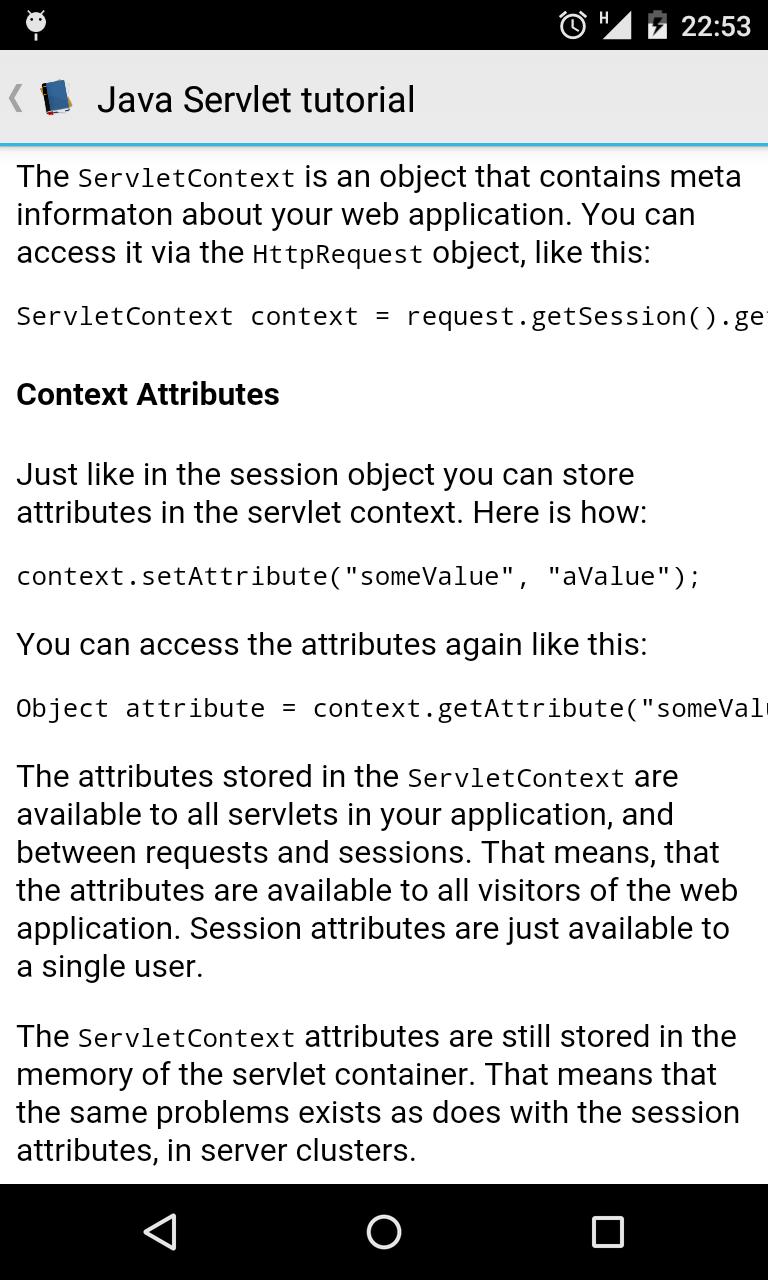
After learn this app Java Servlet tutorial will be help you know servlet and implement a servlet with java.
Versi Terbaru
1.2Diunggah oleh
Andres Cuellar
Perlu Android versi
Android 3.0+
Kategori
Gratis Buku & Referensi APLIKASIRating konten
All ages
Last updated on Apr 13, 2017
update content



APKPure - Toko aplikasi multi-platform yang terutama berfokus pada Android, menyediakan konten terkait aplikasi yang luas. Temukan aplikasi yang Anda inginkan dengan lebih mudah, cepat, dan aman, dengan unduhan dan pemasangan yang cepat dan efisien.