

Package Name:au.com.lionforce.planetexplorer
SHA-256:864137e011d4e640e6fa1a3bf2ae3b7706d45b2d5c0878ccf4dd534999fa30b4
Show More

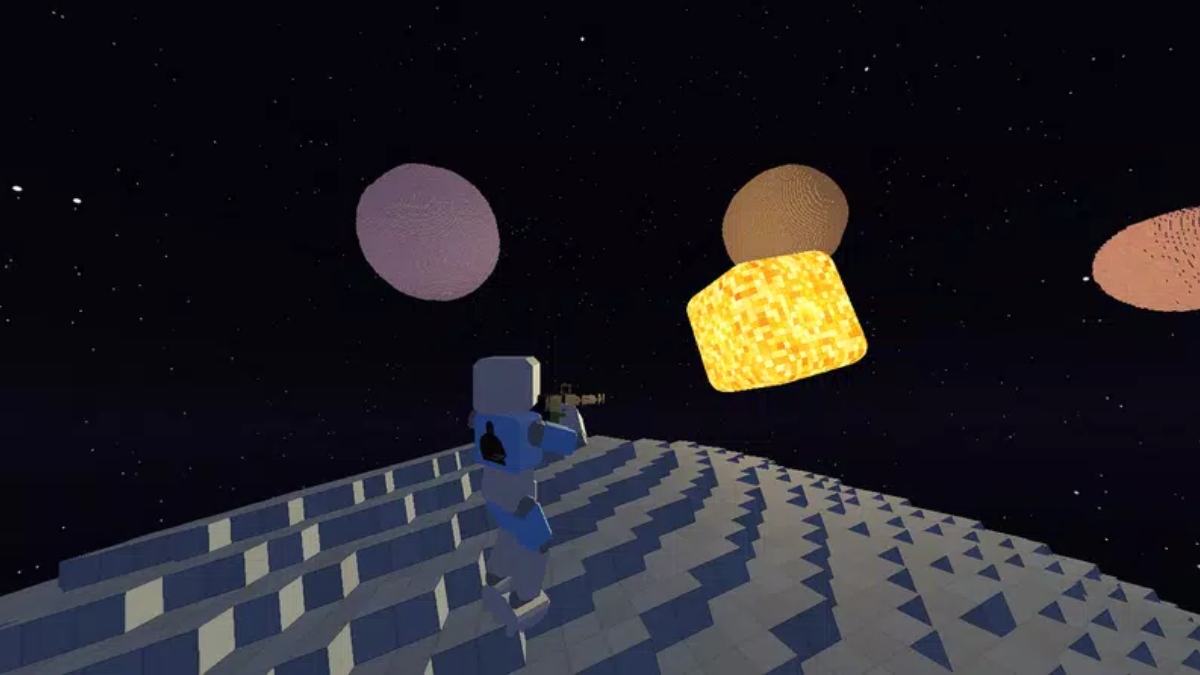
Take a survey craft anywhere in the solar system. Twenty-four worlds — the Sun, all eight planets, five dwarf planets and ten famous moons — and not one of them is a photograph. Every surface is generated on your device as you arrive: Jupiter's counter-flowing cloud bands with the Great Red Spot drifting between them, Saturn's stripes under real ring gaps, Io's volcanoes, Europa's cracked ice, Haumea tumbling end over end.
TWELVE SURVEY MISSIONS
Each mission is a clue rather than a waypoint. "Find the moon that orbits its
planet backwards." Work out which world it means, fly there, descend close and hold position to survey it. Every debrief is a real fact, and your badges are saved.
REAL RELIEF, REAL PLACES
Solid worlds carry a height map, so craters have raised rims and Valles Marineris is genuinely a gash four thousand kilometres long — visible on the planet's silhouette and sharpest along the terminator. Turn on landmarks and the real places name themselves at their real coordinates: Olympus Mons, Tycho, the Sea of Tranquility where Apollo 11 landed, Caloris, Sputnik Planitia, the Cassini Division. Worlds we have only ever seen as cloud, like Venus, honestly have nothing to show.
THE VIEW FROM A MOON
Select a moon and its planet hangs in its sky — Saturn looming over Enceladus, Jupiter's bands churning above Io, Earth floating over the Moon with its clouds still moving. The sky moves too: the planet circles at the moon's real orbital
direction and waxes through phases. Every moon is tidally locked, so the host stays over the same face, and Pluto and Charon each keep one face toward the other, as they really do.
TIME WARP
One second of flight is six minutes of local day on every world. Speed that up
to sixty times and the physics becomes something you can watch: the terminator sweeping across the ground, Haumea turning end over end every four hours while Venus barely creeps.
SCIENCE LAYERS
One tap draws the schematic — spin axis with the poles marked and the real axial tilt, the equator, the direction of rotation, the sub-solar point and the
terminator. Uranus lying on its side at 98°, Venus upside down at 177° so its
spin runs backwards, Triton turning against its own orbit: things to see rather
than take on trust.
A SENSE OF SCALE
The target and Earth drawn at one scale, which is the point — next to the Sun,
Earth is a dot you have to hunt for. Then the whole solar system shrinks until
the Sun is a 30 cm beach ball, Earth a peppercorn 32 metres away, Neptune a marble most of a kilometre off. Distances are measured in things that take time: how long sunlight takes to arrive, how long a radio call would take, how many
years an airliner would need.
YOU, HERE
Enter your weight and age and every world tells you what you would weigh there and how high you could jump — 35 metres on Enceladus — from real surface gravity.
BUILT TO BE HARMLESS
No advertising. No in-app purchases. No accounts. No analytics. No network
requests of any kind, so it works in a tunnel or on a plane. The app requests no Android permissions at all — the permission list on this page is empty, and that is not a policy, it is how it is built.
Every number, every clue and every debrief is real science, written to be read by someone young.
Latest Version
1.0.1Uploaded by
Corentin Bomon
Requires Android
Android 10.0+
Category
Free Educational GameContent Rating
Everyone
Security Report
Check Now
Report
Flag as inappropriateLast updated on Oct 27, 2026
Sharper ground on a close pass. Coastlines, crater rims and ice edges now break up into bays, headlands and shoals as you fly in, instead of going soft.



APKPure - A multi-platform app store primarily focused on Android, providing extensive app-related content. Discover the app you want easier, faster, and safer, with quick and efficient downloads and installations.