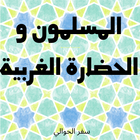
Muslims and Western Civilization is the title of a book written by the Saudi thinker, Safar al-Hawali, which was published in 2018.
book chapters
• an introduction
• The superiority and progress of Islamic civilization
• A summary of Islamic creedal history, including Sufis, Murji'ah and Rafidah
• Renewing Islamic civilization with the Salafist call
• Religious thought
• political thought
• social thought
• Scientific thought
• human thought
The way out of the West's plot and how Muslims lead human civilization
Who is the future for?
• Conclusion
The subject of this book is the last episode of the East-West relations, which took place during the last two centuries, in their cultural aspect, and in their impact on Islam in particular, and these are relations that were distinguished from other relations that took place before with a certain character, due to the circumstances of this contact that are different All the conditions and circumstances that preceded it, it was a connection that differed from all the conditions and circumstances that preceded it, the connection of Islam with other civilizations and cultures was always the connection of the winner with the loser, or the connection of peer to peer.
As for his contact with the West in this last period, it was the connection of the defeated with the victor, and the defeated (he is always fond of redeeming the conqueror in his slogan, his dress, his manners, and all his conditions and habits), as Ibn Khaldun says.
The topic is long and multifaceted, in which dozens of books written by orientalists appeared in the development of modern Islamic thought, and in tracing the impact of Westernization, or what they call (Westernization) in various Muslim countries, thus helping the detractors of the colonial men to the correct assessment, to review what was, and to monitor What will be, from their plans.
My intention in these chapters was not to investigate this complex subject, nor to enumerate its stages and fields, but I intended to open this door, which the Arabs and Muslims did not enter, and they did not notice its importance and danger, given the many preoccupations of the West and its researchers in the last half century in particular. And after World War II in particular.
In these chapters, I traced the development of modern Islamic thought as a result of its mixing with Western thought and Western civilization since the beginning of the first phase at the hands of Rifa'a al-Tahtawi, Khair al-Din al-Tunisi and Jamal al-Din al-Assad Badi, known as al-Afghani and his student Muhammad Abduh, to the subsequent stages and developments after World War II.
I have depicted this development from its two sides: On the Islamic side: who sought to borrow the good from contemporary Western thought to use it in its renaissance in which it tries to catch up with the path of civilization, and from its western side: which tries to imprint the Islamic world with its civilized character, and encourages the creation of thought A developed Islamic justifying Western patterns, seeking to erase the distinctive character of the Islamic personality, in order to help create stable relations between him and the Islamic countries that serve his interests.
Latest Version
2Uploaded by
Hala Hatamleh
Requires Android
Android 5.0+
Category
Free Books & Reference AppContent Rating
Everyone
Report
Flag as inappropriateLast updated on Mar 29, 2023
Minor bug fixes and improvements. Install or update to the newest version to check it out!



APKPure - A multi-platform app store primarily focused on Android, providing extensive app-related content. Discover the app you want easier, faster, and safer, with quick and efficient downloads and installations.