

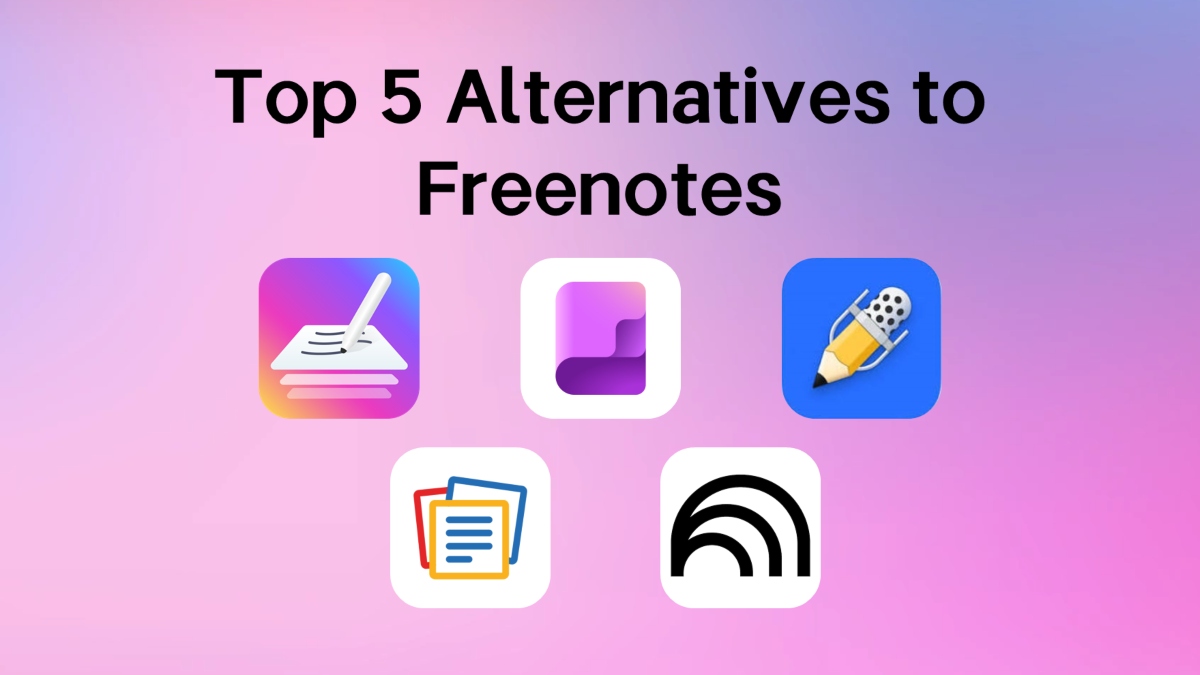
Top 5 Alternatives to Freenotes

2026-05-14
Find your ideal Freenotes alternatives with detailed breakdowns of their key features, pros, cons, and additional valuable specifics.

Freenotes is a note taking app that combines realistic handwriting with tools for study and work.
Freenotes is a polished, pen‑forward note app that many users love for handwriting, quick capture, and AI-enhanced organization. However, some people want alternatives for different platforms, feature sets, or pricing. Below are five solid substitutes: Kilonotes, Notability, Nebo, Zoho Notebook, OneNote and NotebookLM, each described with who it's best for and the standout features to help you pick the right replacement for your workflow.
1. Kilonotes
- Best suited: Students and course learners
- Best for: Fast PDF reading & annotation, creating study cards, quick review sessions and lightweight organization across mobile and tablet.
- User rating: 4.3/5 on Google Play
Kilonotes is a note-taking app that supports handwriting, PDF annotation, and study organization.
Kilonotes - a flexible, modern note app that focuses on lightweight organization and fast capture. This note app is a good choice for users who want a simple structure without a heavy setup. It typically offers clean text and media notes, quick search, and cross‑device sync, so it’s helpful if you move between phone and desktop often.
Pros:
strong PDF annotation and basic card‑learning features
clean UI for quick capture
good cross‑device sync for basic workflows.
Cons:
The feature set is more basic than heavyweight note apps (limited advanced knowledge‑management tools)
2. Notability
- Best suited: Lecture‑taking students and professionals
- Best for: Handwriting + audio recording (lecture capture with synced audio playback), fast annotation of slides/PDFs, and quick ink-based editing.
- User rating: 4.8/5 on iOS App Store
Bring ideas to life with Notability - Easy Note Taking App!, goodnotes,collanote
Notability is aimed at students and professionals who mix handwriting, typed text, and audio recording in the same note. Its strengths are excellent stylus support, multi‑modal notes (handwriting + audio), and a polished UI for organizing notebooks, which mirrors Freenotes’ pen‑centric strengths while adding strong audio and annotation features.
Pros:
industry‑leading audio
handwriting sync
excellent stylus support
built‑in study tools (quizzes, flashcards)
AI productivity features on paid tiers.
Cons:
platform availability is iPad/Mac/web first
advanced features may require subscriptions
3. Zoho Notebook
- Best for: Best suit: Casual note‑takers and creatives
- Best for: Multimedia notes (text, sketches, voice, photos) in a card‑based visual layout, offline use, and simple cross‑device sync without cost.
- User rating: 4.3/5 on Google Play
Notes, notepad, to-do lists, reminders & voice notes in one app
Zoho Notebook is a free note‑taking app that organizes content as customizable “note cards” (text, checklist, audio, sketch, photo, and file cards) and syncs across web, desktop, and mobile via Zoho’s cloud. The app emphasizes a clean, tactile design with notebook covers, card layouts, and simple gestures rather than heavy power‑user features.
Pros:
Free forever
Attractive, card‑based UI
Multiple note types
Cross‑platform sync and offline access
Note locking (passcode/biometric) for individual notes.
Cons:
Limited advanced organization
Export and integration limits
Performance and feature quirks
Collaboration and team features
4. OneNote
- Best suited: Students, researchers, and teams
- Best for: Freeform, multimedia note organization (notebooks → sections → pages), collaboration via Teams/OneDrive, and complex project or course-level note management.
- User rating: 4.6/5 on Google Play

Powerful notepad to capture ideas & save notes. Easily organize & share notes
Microsoft OneNote is a digital notebook app that organizes notes into notebooks, sections, and pages on an effectively infinite canvas, letting you mix typed text, handwriting, images, audio, files, and web clippings in the same place. It syncs via OneDrive so notes are available on Windows, Mac, web, iOS, and Android, and integrates with Microsoft 365 apps and Teams for collaboration and sharing.
Pros:
Very flexible organization
Rich multimedia support
Strong Microsoft 365 integration
Cons:
Interface complexity
Sync reliability
Limited advanced document‑style formatting
Feature parity differences
5. NotebookLM
- Best suited: Researchers, grad students, and knowledge workers
- Best for: AI‑driven document Q&A, cross‑document summarization, flashcard/quiz generation from uploaded materials, and rapid literature review or onboarding of long documents.
- User Rating: 4.8/5

Google NotebookLM is a research and learning app that delivers answers grounded in your own sources.
NotebookLM is a language‑model‑backed notebook that you "ground" in your own files (PDFs, Google Docs/Slides, web URLs, text, transcripts, and audio) so the AI answers are explicitly based on the sources you provide. It was introduced as an experimental Google Labs product (originally Project Tailwind) and is designed as a virtual research assistant that helps you synthesize many documents quickly rather than produce generic web‑trained answers.
Pros:
Fast summaries and synthesis
Large context window and multi‑source Q&A
Study aids and learning features
Source linking / citations
Cons:
Occasional inaccuracies (hallucinations)
File and formatting limits
Cross‑device sync quirks
Privacy and cloud model
 NEWS
NEWS REVIEWS
 HOWTO
HOWTO News
News